One of Cormac's Public Rights of Way Country Officers, Ritchie Tassell, has developed a clever and resourceful initiative to create nest boxes using waste drainage pipe. The project not only supports the waste hierarchy by re-purposing material that would otherwise go to landfill but also helps address the growing shortage of natural nesting sites, actively supporting biodiversity.
There is a significant reduction in nesting capacity for birds due to several factors:
Loss of mature trees, where large natural cavities typically form
Fewer cavities in modern buildings due to reduced use of timber
Many tree species do not naturally form large cavities
Large tree cavities are the only suitable natural nest sites for some of our bigger hole-nesting bird species.
Artificial nest boxes are an effective way to help address this issue. An added benefit of this project is that the boxes are created from repurposed waste materials. In this case, twinwall polypipe are being used to provide nesting locations where they would not otherwise exist.
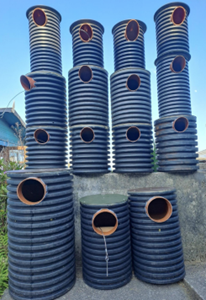
Offcuts of twinwall polypipe are transformed into high-quality, durable nest boxes in a variety of designs. The material is routinely used by Cormac for drainage projects and frequently generates offcuts of one metre or less, which are unsuitable for reuse and currently non-recyclable, meaning they are typically sent to landfill. However, with minimal skilled labour, no specialist tools, and no additional materials, these offcuts can be readily repurposed into valuable wildlife infrastructure.
Most pipe diameters can be adapted to create different nest box designs to suit a range of bird species, including:
House sparrow terraces (replicating building crevices)
Tawny owl, kestrel or jackdaw boxes (replicating large tree cavities)
Small-hole boxes for tits, pied flycatchers and redstarts (replicating smaller tree cavities)
Small horizontal open-fronted boxes for wagtails (installed near suitable rivers or streams to replicate cavities in stonework)
After seeking advice from Cornwall Wildlife Trust about the suitability of plastic twinwall pipe as a material for nest boxes, they advised “unless they have an internal layer of insulation they are likely to get very hot and not be used for nesting’’. To test this theory, Ritchie undertook an experiment in extreme conditions, using his nest boxes and comparing this with the market leader (the Schwelger Tawny Owl Box). Interestingly, the repurposed polypipe nest box was consistently maintaining temperatures 2-3°C cooler than the market leader, making them more than suitable.
Ritchie has already installed several boxes at various locations:
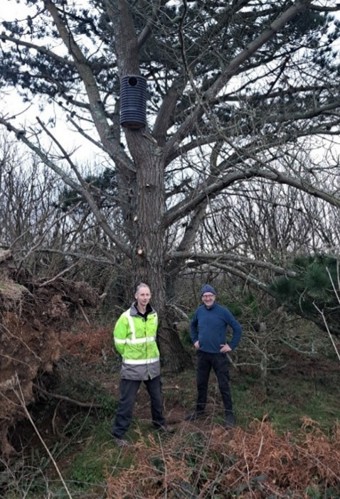
One large barn owl box at Tehidy Park
One tawny owl box and one kestrel box are ready for installation at Tehidy Park
One large barn owl box and one tawny owl box on private land near Carclew House
With the nesting season approaching, we’re hopeful the new boxes will soon be put to good use.
Pictured below: from pipes to perches, the polypipe nest boxes
Email: contactus@corservltd.co.uk